 Flickr
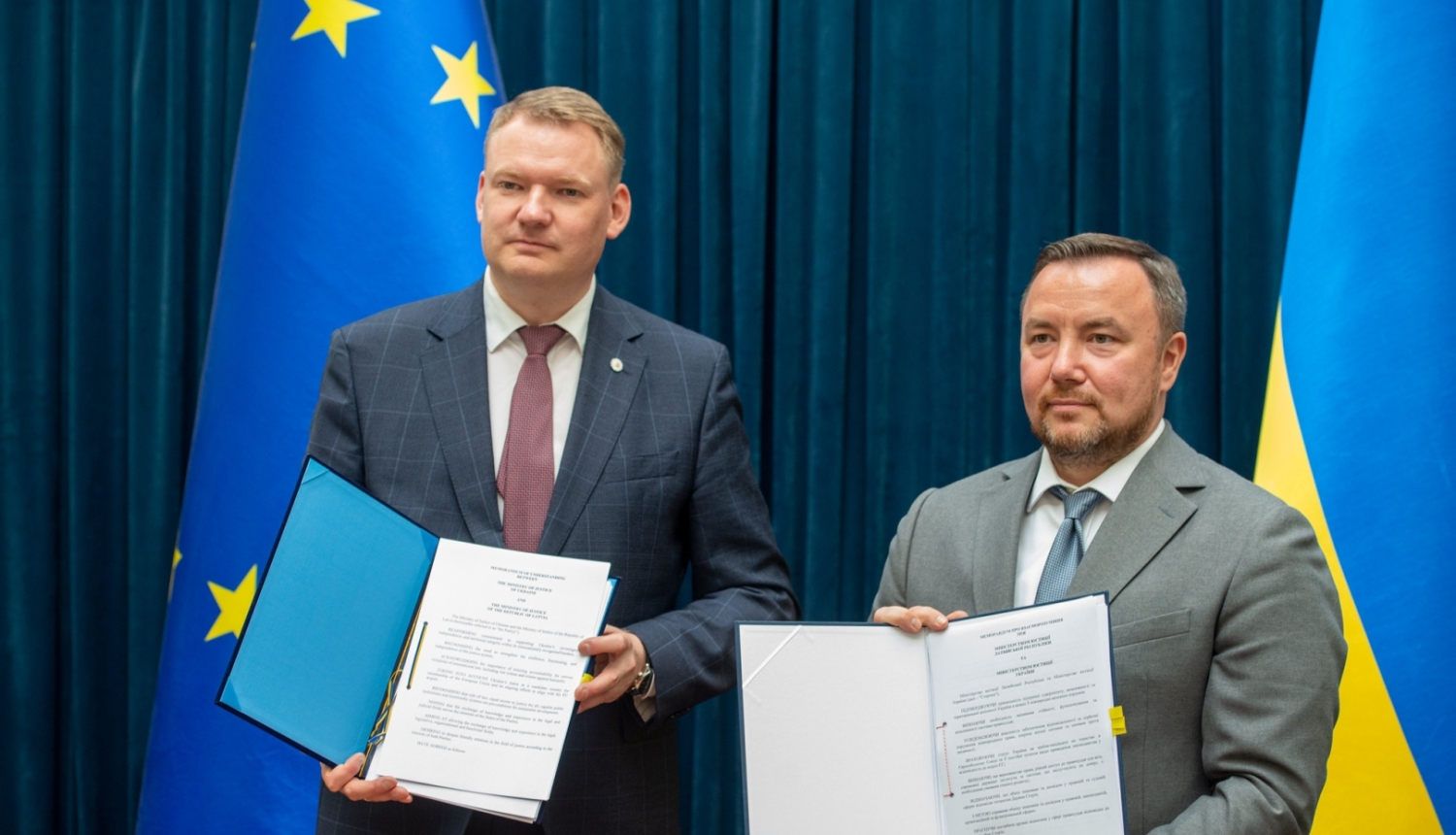
Minister of Justice Edvards Smiltēns, together with Ukrainian Minister of Justice Denys Maslov and Lithuanian Minister of Justice Rita Tamašunienė, agreed to strengthen practical cooperation in the implementation of Ukraine’s judicial reforms. During the visit to Kyiv, a memorandum of understanding was also signed between the Ministries of Justice of Latvia and Ukraine, which provides for the transfer of expertise from Latvian experts in the areas of the rule of law, judicial system development, anti-corruption, digitization, and other fields.
Ukraine’s path toward the European Union has now entered a phase in which political commitments must be translated into concrete reform results. In June of this year, a Fundamentals cluster of negotiations on key issues was launched, covering the judicial system, fundamental rights, the rule of law, and freedom and security. Ukraine’s path toward the European Union has now reached a decisive stage of reform. Therefore, the pace and quality of judicial reforms will be one of the key determinants of how rapidly Ukraine continues on its path toward European Union membership.
In July, Denys Maslov assumed the position of Ukraine’s Minister of Justice; he previously chaired the Ukrainian Parliament’s Committee on Legal Policy and has personally been involved in advancing judicial reform. Latvia views this change in leadership as an opportunity to give new momentum to reforms at a time when Ukraine must fulfill specific commitments in the areas of the rule of law and anti-corruption. Denys Maslov was appointed to the position on July 16, 2026.
“Ukraine’s place is in the European Union. However, the pace of this accession will now be determined not by political statements, but by very concrete actions to reform the justice system. We are not in Kyiv to stand on the sidelines and list what has not been done, but to help drive the reforms forward. Ukraine is implementing reforms under wartime conditions, and we are well aware of this. Our responsibility as close partners is to assist where Latvia’s experience can make a practical contribution, to expedite decision-making, and to help maintain the momentum of the reforms,” emphasizes Minister of Justice Edvards Smiltēns.
A joint statement by the European Commission and Ukraine identifies ten priority reforms in the rule of law, the implementation of which is essential for Ukraine’s further progress toward the European Union.
These include improving criminal procedure, strengthening the judicial selection system, reforming the State Bureau of Investigation, implementing anti-corruption policies, and strengthening the independence of National Anti-Corruption Bureau of Ukraine and the Specialized Anti-Corruption Prosecutor’s Office.
Latvia is ready to provide not only political support but also concrete expert experience in this process. Practical cooperation between the judicial institutions of both countries is already underway: the State Bureau of Forensic Expertise is collaborating with Ukrainian experts on documenting war crimes; the Court Administration is working with the Supreme Court of Ukraine on issues of European integration and digitization; while the State Probation Service works with Ukrainian probation and correctional institutions. The next step is to deepen this cooperation in areas where the experience of Latvia and Lithuania can help Ukraine more quickly implement the judicial reforms necessary for European Union integration.
“We ourselves have walked the path to European Union accession. We know how much, in this process, it matters not only to pass laws but also for institutions to have the capacity to actually implement them. It is precisely this experience that we can offer Ukraine. Not just theory, but what we ourselves have succeeded in, where we’ve made mistakes, and what we would do differently today. If this allows Ukraine to complete even a few stages of reform more quickly and more securely, that is very concrete assistance from Latvia on Ukraine’s path to Europe,” notes E. Smiltēns.
At the same time, this cooperation will not be one-sided. During the war, Ukraine has gained experience that no other European Union member state has. Courts and other institutions of the judicial system continue to operate during drone attacks, power outages, and in the wake of infrastructure damage. Latvia will draw on Ukraine’s practical experience in ensuring the continuity of court operations, the resilience of digital systems, and the functioning of institutions under crisis conditions.
The signed memorandum also covers cooperation in preventing and combating corruption, improving state-provided legal aid, developing the probation and correctional systems, enforcing court rulings and conducting expert assessments, as well as digitizing the judicial system. This includes expert consultations, training, the exchange of experience, and the implementation of joint projects.
A separate area of cooperation is holding Russia accountable for its aggression and international crimes. Latvia will continue to support the establishment and operation of the Special Tribunal for the Crime of Aggression against Ukraine, the development of an international mechanism for compensation for damages, the documentation of war crimes, and the return to Ukraine of children who were unlawfully deported or forcibly displaced from Ukraine.
