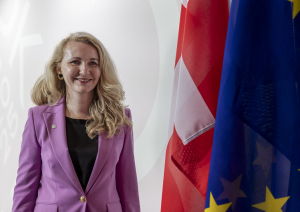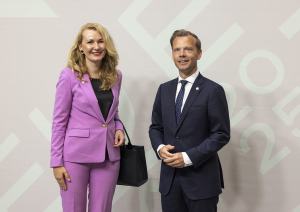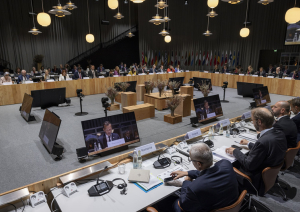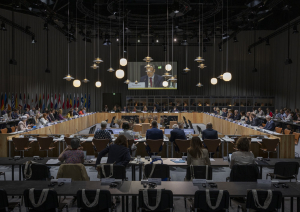

On Wednesday, 23 July, in Copenhagen, Minister of Justice Inese Lībiņa-Egnere took part in the informal meeting of the European Union Justice and Home Affairs Council. During the meeting, EU justice ministers discussed the application of the General Data Protection Regulation (GDPR) with a view to reducing the administrative burden on small and medium-sized enterprises. Ministers agreed on the need to continue strengthening the EU’s competitiveness by cutting bureaucracy.
“We must seize the opportunity to reduce administrative burdens and simplify the application requirements of the GDPR for small and medium-sized enterprises. We need to help European businesses become more competitive globally, especially in this era of rapid artificial intelligence development. At the same time, it is essential to maintain a high standard of personal data protection. The requirements must be reasonable and proportionate to the circumstances, avoiding unnecessary burdens on those applying the GDPR and allowing greater focus on innovation and business development,” emphasised Minister of Justice Inese Lībiņa-Egnere.
According to the Minister, administrative burdens should be reduced through a risk-based approach, clear guidelines and training, particularly for small businesses and non-governmental organisations, while preserving the GDPR as a global standard and refraining from revising it until existing mechanisms have been fully utilised. Any further improvements should be prepared in close dialogue with the business community.
The Minister also stressed the need to find better solutions for informing individuals and obtaining consent for data processing. At present, websites often provide either excessively lengthy explanations or, conversely, single-sentence notices whose meaning is not understood by users, who simply click through to proceed.
Special attention at the meeting was also given to a phenomenon currently relevant in the EU in the field of organised crime, namely criminal groups linked by family ties. Such groups exploit the right not to testify against relatives, coordinate defence strategies and involve family members in committing and concealing crimes. The persistent family connections between members of these criminal groups significantly complicate investigations, prompting ministers to discuss national experiences and possible solutions at the European level.
In addition, justice ministers discussed ways to reduce violence against children within families. It is essential to detect violence as early as possible and protect children from repeated trauma. States must establish close intersectoral cooperation, educate teachers, medical professionals and social workers, and encourage the public to report suspicions, explained Inese Lībiņa-Egnere. When abuse is identified, children should be granted the status of particularly protected victims, with a child-friendly approach, in order to uncover violence more quickly and ensure that victims receive safe, understandable and dignified support, the Latvian Minister of Justice stated.