


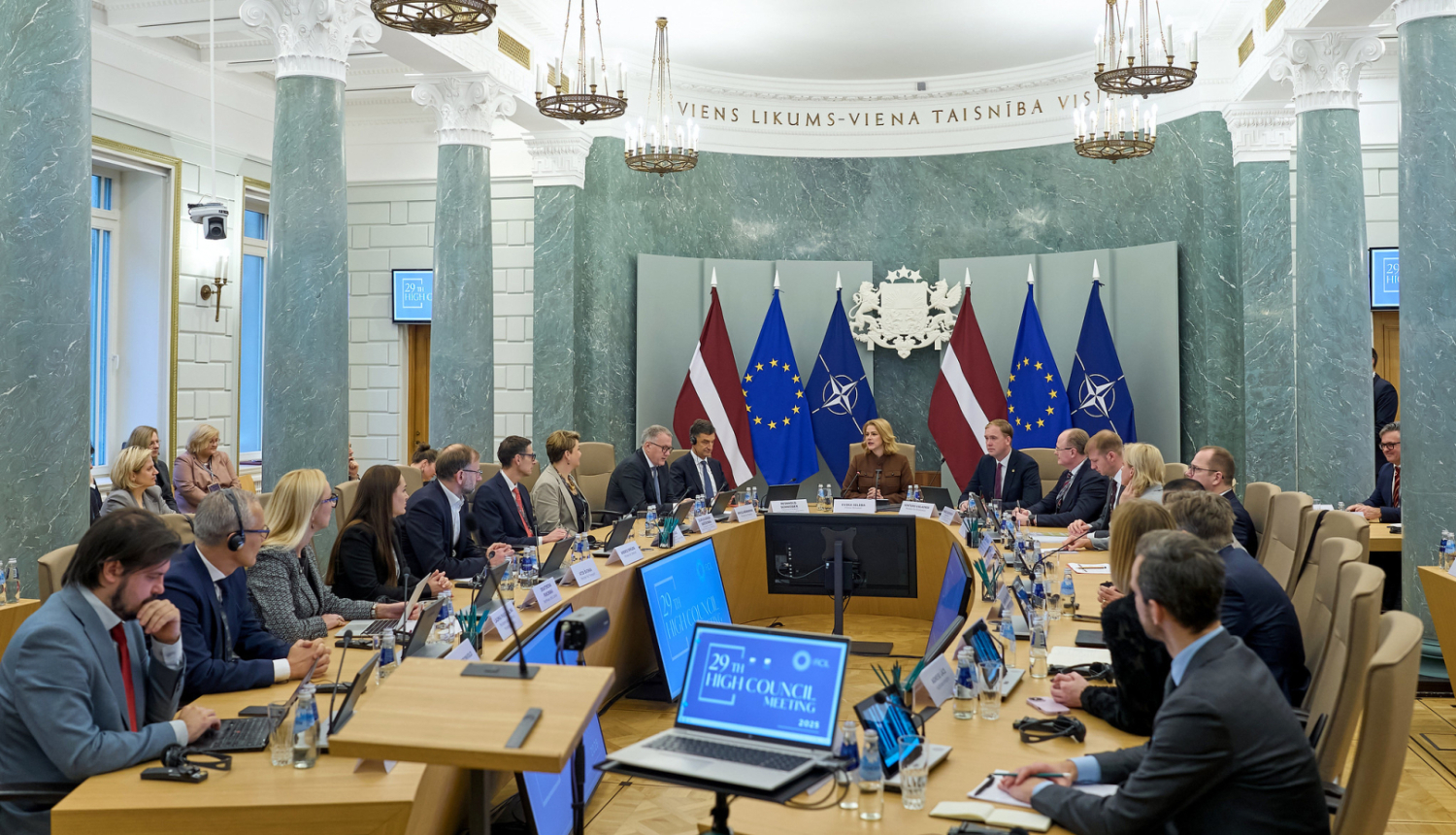
On 31st October, a high-level meeting was held between the Latvian government and the Foreign Investors Council in Latvia (FICIL). The joint goal of the government and FICIL is to enhance Latvia’s competitiveness, attract foreign investment, and improve the business environment. FICIL representatives praised the Ministry of Justice for its work in strengthening the rule of law, reducing bureaucratic burden, and creating a supportive environment for entrepreneurs.
Parliamentary Secretary Lauma Paegļkalna represented the Ministry of Justice at the meeting: “The reforms implemented by the Ministry of Justice demonstrate consistent and sustainable efforts to improve Latvia’s investment climate. Less bureaucracy, faster processes, and a stronger judicial system create the conditions for increased investor confidence and enhanced national competitiveness. The goals of the state and investors are aligned — to continue building a responsible, predictable, and cooperation-oriented business environment in Latvia.”
In recent years, the Ministry of Justice has implemented numerous measures directly improving the business environment and reinforcing Latvia’s reputation as a law-abiding and reliable country.
Latvia currently ranks 21st in the World Justice Project rule of law index, maintaining steady progress and demonstrating the resilience of its legal system at a time when rule of law is declining in many countries. The European Commission’s 2025 Justice Scoreboard also highlights Latvia’s progress, noting that the country has one of the most digitalized court systems in the EU, ensuring faster case resolution and transparency. Latvia also ranks among the EU countries with the shortest civil and commercial case resolution times.
The Ministry of Justice has carried out several reforms directly benefiting the business environment and reducing bureaucracy. For example, the Company Register’s digital service on the portal “registrs.ur.gov.lv” allows the registration of a limited liability company (SIA) within minutes, with the system automatically preparing the required documents, significantly simplifying company formation. More than 80% of new companies are already using this service.
The share capital payment process has also been simplified — entrepreneurs with a share capital of up to €50,000 no longer need to submit a certificate of payment, and founders can evaluate in-kind contributions themselves. This applies to 94% of all capital companies, reducing administrative burden and saving time for both entrepreneurs and state authorities.
Another important step in strengthening the investment environment is expanding the competence of the Economic Court. Amendments promoted by the Ministry of Justice ensure that the court focuses on complex commercial and financial disputes, providing entrepreneurs with more predictable and higher-quality judicial practices. At the same time, court digitalization is being strengthened — artificial intelligence tools are being implemented for document anonymization, speech transcription, and streaming, with full automation of debt enforcement processes planned by 2026.
Foreign investors also welcome reforms that make access to the judicial system simpler and more transparent. This year, amendments to the Civil Procedure Law, developed by the Ministry of Justice, came into force, simplifying the previously complex system for calculating state fees. All state fees are now fixed and better aligned with the requirements.
The Justice Academy has started operating — a unified training and professional development platform for judges, prosecutors, and court staff. It strengthens judicial competence in economic and business matters, contributing to high-quality and timely case resolution.
In parallel with ongoing achievements, the Ministry of Justice continues to work on new solutions to further simplify the business environment. From January 2026, a unified construction and real estate registration process will be introduced, combining building plans, cadastre, and land registry stages into a single digital workflow.
The Ministry is also promoting a full transition to electronic operations in the Company Register, ensuring that company registration and communication with the state occur entirely digitally. Digitalization and efficiency improvements in the judicial system will continue, including further development of the Economic Court’s competence and the introduction of artificial intelligence solutions in the e-case platform.