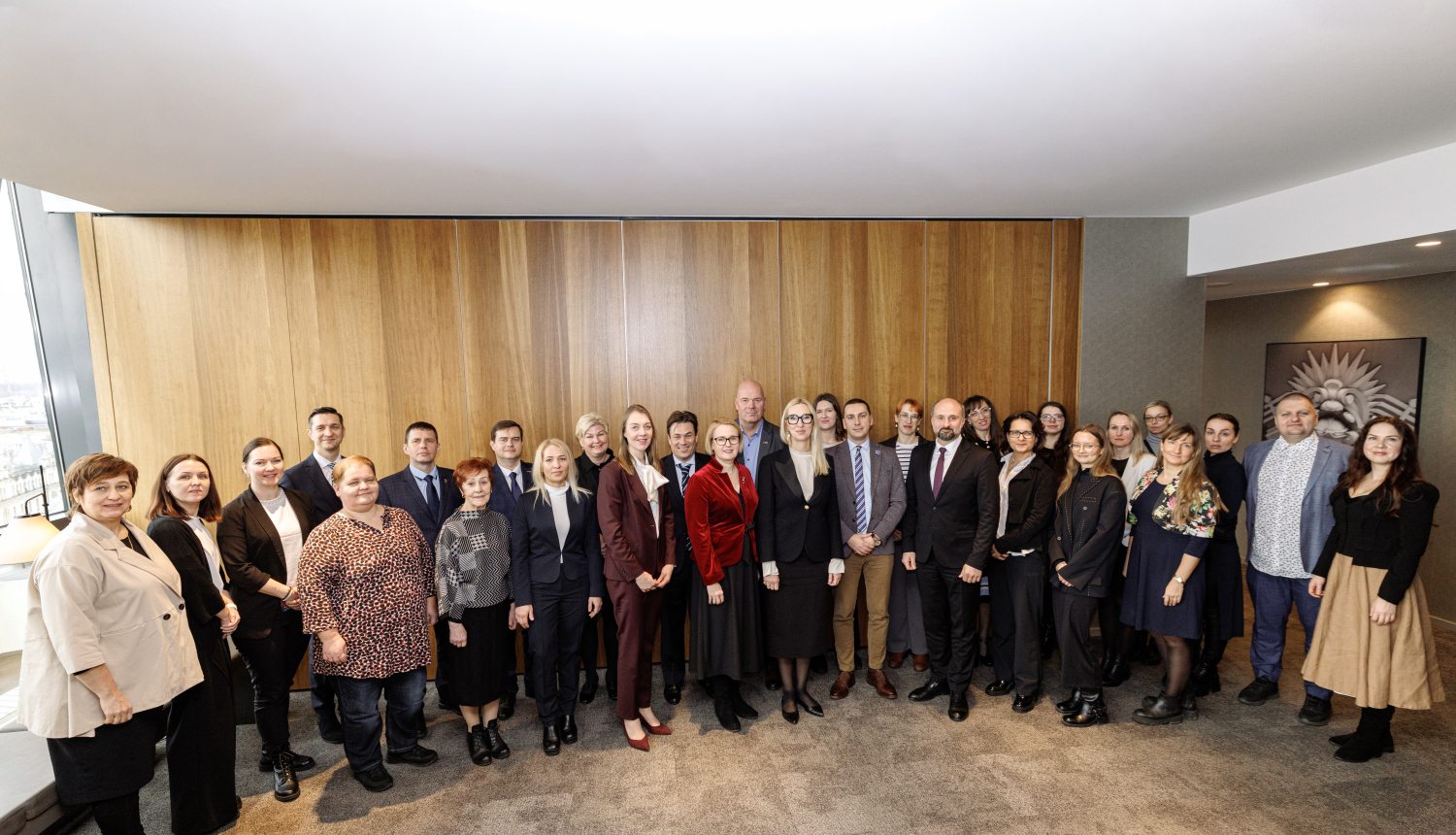
On Friday, 12 December, the Ministry of Justice launched the Norway Financial Mechanism programme “Corrections Services,” designed to bring a range of significant improvements to Latvia’s penal system. The programme focuses on creating a modern women’s prison in Cēsis, strengthening the capacity of correctional services, and developing rehabilitation services for children with substance abuse dependencies.
At the launch event, Parliamentary Secretary of the Ministry of Justice Lauma Paegļkalna highlighted the importance of cooperation: “On behalf of the Ministry of Justice, I thank the Kingdom of Norway and the Norwegian Correctional Services for long-standing professional collaboration, knowledge and experience exchange, and their significant contribution to the development of Latvia’s correctional system. Norway’s approach, grounded in respect for human dignity and resocialization, has become a stable foundation for important reforms in Latvia. This cooperation confirms our shared belief that modern corrections are an investment in public safety, and resocialization is the most effective way to prevent recidivism in the long term.”
During the event, L. Paegļkalna presented a letter of appreciation from the Prime Minister to Kim Ekhaugen, Head of the International Cooperation Department at the Norwegian Correctional Services Directorate, recognizing his professional and long-term contribution to Latvia’s correctional development, promotion of international cooperation, and introduction of innovative approaches.
The launch also presented the Prison Administration project “Woman – A Second Chance for Better Social Integration” (SOLIS), which outlines targeted measures to improve women’s resocialization.
One of Justice Minister Inese Lībiņa-Egnere’s key priorities is the creation of a new women’s prison. Currently, the only women’s facility in Latvia is in Iļģuciems, housing 188 inmates, including a mother-and-child unit where children up to four years old can live with their mothers. The facility provides inmates with opportunities to acquire childcare skills and other competencies to facilitate successful reintegration into society.
State Secretary of the Ministry of Justice Mihails Papsujevič emphasized the need for new infrastructure for women: “We see that the existing prison infrastructure in Latvia no longer provides women with what is most essential – safety, dignity, and the opportunity to truly recover and reintegrate. The outdated Iļģuciems facilities hinder resocialization work and create daily tension and insecurity. This particularly affects mothers with young children, who need an environment where their child can grow safely and the mother can regain strength for a new beginning.”
Under the SOLIS project, plans include:
-
Construction of a new women’s prison in Cēsis (92 places)
-
Development of an open-type women’s prison unit in Olaine (50 places)
-
Establishment of a mother-and-child unit
-
Staff training and professional development
-
Close cooperation with NGOs and the ESF project “DARI” in resocialization activities
The event also showcased the Ministry of Health and National Health Service pilot project “Institutional Cooperation for Reintegration of Minors with Substance Use Disorders,” aimed at improving access to rehabilitation services, strengthening inter-institutional cooperation, ensuring continuous support, and promoting educational and social reintegration opportunities for youth post-rehabilitation.
The programme’s total funding amounts to €17.6 million, including €10.2 million for the new women’s prison infrastructure. The SOLIS project has a total budget of €12.9 million, while the National Health Service pilot project is budgeted at €3.2 million.
The launch was attended by representatives of the Ministries of Justice and Health, the Prison Administration, the Norwegian Embassy in Latvia, and representatives of the Council of Europe and the Norwegian Correctional Services, emphasizing the importance of international cooperation in implementing long-term reforms. Discussions focused on creating suitable infrastructure for women and its significance for resocialization and public safety.
Additional information:
EEA and Norway grants are provided by Iceland, Liechtenstein, and Norway to promote a more socially and economically balanced Europe and strengthen cooperation between Iceland, Liechtenstein, Norway, and the beneficiary country – Latvia.