


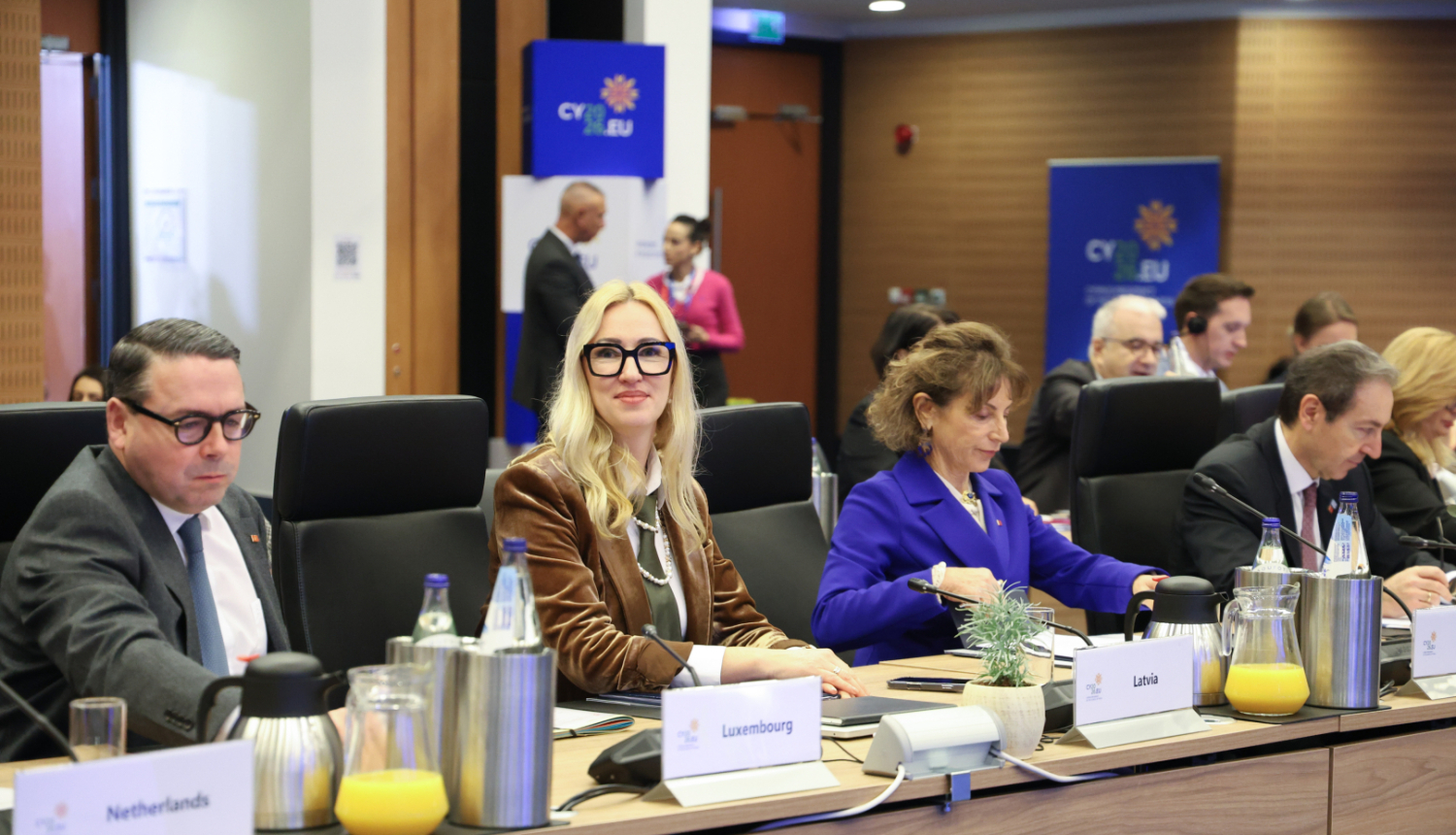
On 23 January 2026, Parliamentary Secretary of the Ministry of Justice Lauma Paegļkalna participated in the informal meeting of the European Union Justice Ministers in Nicosia, Cyprus. During the meeting, representatives of the member states exchanged views on more effective recovery of criminal assets, the legal challenges of cross-border restitution of illegally exported cultural objects, and the promotion of alternatives to detention, with particular attention to juveniles and persons with substance abuse issues.
In discussions on strengthening asset recovery, it was highlighted that organized crime in the European Union generates at least €139 billion in illicit income annually, yet only around 2% of this amount is confiscated. This leaves offenders with financial means to continue and expand their activities, negatively affecting both the rule of law and the legitimate economy. Member states emphasized the need to enhance transparency and monitoring of financial flows, improve access to financial and crypto-asset data, and strengthen cross-border cooperation. While existing EU instruments were deemed sufficient, their implementation and practical application must be fully ensured.
Parliamentary Secretary Lauma Paegļkalna noted:
“Currently, the main priority is the implementation of existing instruments and their effective application in practice. Additional measures at the EU level should only be considered in a targeted manner, based on identified new risks, including those related to crypto-assets and the digital financial environment.”
She also highlighted the need to address challenges in access to information during cross-border investigations, particularly concerning the obligations of financial service providers to share data with competent authorities.
Another topic on the agenda was the cross-border movement of illegally exported cultural objects. Illicit trade in cultural objects is one of the most profitable illegal markets globally, ranking third after drug and arms trafficking. Differences in member state legal frameworks allow criminals to deliberately move stolen cultural assets to jurisdictions with more favorable laws, significantly hindering their recovery. During the meeting, EU member state representatives discussed ways to strengthen legal frameworks and ensure the return of objects to their countries of origin.
Latvia supported the enhancement of procedural and jurisdictional solutions at the EU level to improve the efficiency of asset recovery. Paegļkalna emphasized:
“Legal fragmentation at the EU level facilitates the deliberate use of jurisdictions for criminal purposes. A more coordinated approach among EU member states in recovering cultural assets could promote their more effective return to countries of origin, respecting cultural heritage while protecting individuals who obtained such items legally.”
Discussions on criminal justice policy also focused on alternatives to detention for juveniles and young offenders, including those with substance abuse issues. EU prisons currently hold nearly half a million people, and incarceration often fails to improve either public safety or successful reintegration. Studies show that treatment- and rehabilitation-based approaches significantly reduce the risk of reoffending and are more effective in the long term.
Member states agreed that detention should be a last resort for juveniles and young people. Latvia informed the meeting about measures already implemented to reduce juvenile criminalization and strengthen resocialization. Parliamentary Secretary Paegļkalna stated:
“Punishment alone does not resolve addiction problems and can increase the risk of reoffending among juveniles and young people. It is therefore crucial to strengthen treatment-, rehabilitation-, and social support-based solutions.”
The informal meeting of the EU Council of Justice and Home Affairs Ministers serves as a platform for discussing strategically important issues and exchanging member states’ perspectives on future EU justice policy directions, without adopting binding decisions.