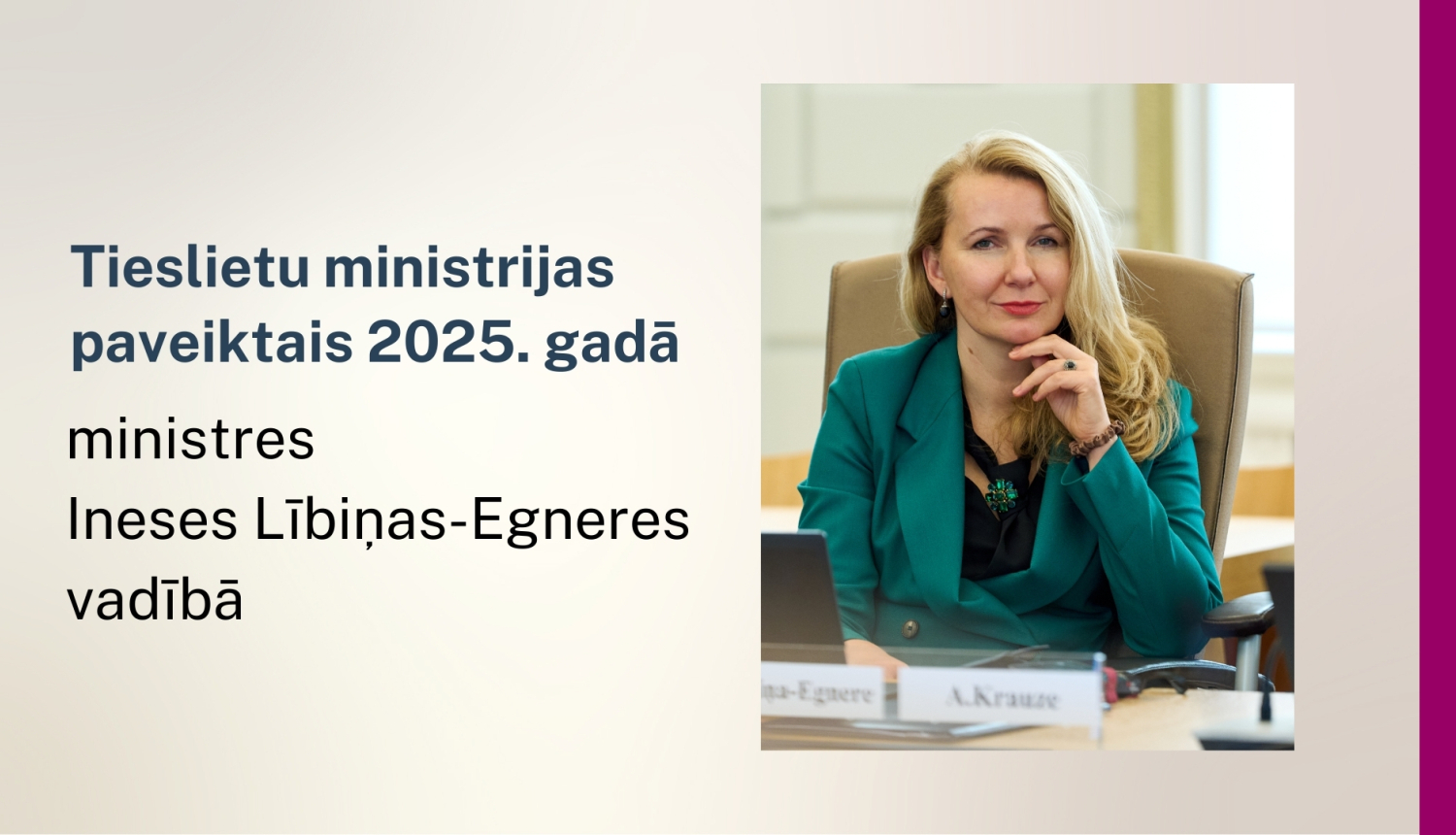
The year 2025 under Justice Minister Inese Lībiņa-Egnere has been marked by significant reforms in the Ministry of Justice, reducing bureaucracy, strengthening the environment for state investments and security, and improving human rights protection. From faster and more convenient services for residents and businesses to targeted support for families, children, and victims of violence, the achievements demonstrate a deliberate drive toward a safer and more just Latvia.
Justice Minister Inese Lībiņa-Egnere emphasizes: “In 2025, we have systematically strengthened the rule of law where society expects it most – in improving the investment environment, protecting families, preventing violence, and ensuring our collective safety. Our goal is to make sure that every action taken translates into real support for people in their daily lives and in their wallets. The results are also reflected in Latvia’s placement in the latest World Justice Project Rule of Law Index, where for the second consecutive year we rank 21st globally, demonstrating a stable rule of law in a time when it is declining in many parts of the world. In 2026, we will continue on this path, standing together to uphold the rule of law and a safe Latvia.”
Reducing Bureaucracy and Attracting Investment
A unified building registration service has been created. From 6 January 2026, building registration will become simpler, faster, and more convenient for residents. Citizens will no longer need to visit multiple institutions and submit the same documents repeatedly, saving time and resources as data will be synchronized across state systems. Already, private houses can be registered in the Cadastre based solely on documentation without an on-site inspection, making the service easier, cheaper, and faster for residents and businesses.
Business processes are also streamlined. Registration of a limited liability company (SIA) with the Register of Enterprises can now be completed in five minutes using automatically generated documents. The service produces documents in both Latvian and English, enhancing Latvia’s appeal to international investors.
Child-Friendly Justice
To prevent retraumatization of children in family disputes, amendments to the Civil Procedure and Notaries Acts prepared by the Ministry of Justice have been adopted in the Saeima. Under the new system, agreements on child custody, visitation rights, and child support reached before a sworn notary during divorce proceedings are directly enforceable as court orders. This ensures that children are not repeatedly involved in lengthy and emotionally taxing court proceedings to resolve disputes that are already addressed in the divorce process.
Child support payments have been increased in both 2025 and 2026.
Strengthening Internal Security
The new Liepāja prison was completed ahead of schedule, saving budget resources. Since the beginning of 2025, the Training Centre of the Prison Administration has been operating in Olaine, improving rehabilitation work and efforts to change the behavior of offenders. A new Norwegian-funded program has been launched to create a modern women’s prison in Cēsis and provide rehabilitation services for children.
The Justice Academy has begun operations, providing training for judges, prosecutors, investigators, and court staff on hybrid threats, violence, and family disputes.
Combating Violence
Significant steps have been taken to strengthen criminal accountability for violent crimes and establish new mechanisms to enhance victim protection. The Ministry of Justice has proposed amendments to the Criminal Law to extend the statute of limitations from 20 to 35 years—or, as decided by the Saeima, to eliminate it entirely—for particularly severe crimes against minors, including sexual offenses, forced abortions, human trafficking, and serious bodily harm.
Latvian society increasingly demonstrates intolerance toward domestic violence. The Council of Europe Convention on preventing and combating violence against women and domestic violence provides rapid and coordinated responses to violence and ensures stable victim protection. The Venice Commission also notes that withdrawal from this convention would reduce protection, weaken victim support, and remove independent international oversight, which helps improve institutional performance.
Amendments to the Civil Procedure Law improve access to the justice system. In divorce, custody, and visitation cases, courts must consider not only the financial positions of the parties but also principles of fairness and proportionality, including the behavior of the parties during the divorce and proceedings. Temporary protection against violence has been strengthened, with shorter deadlines for completing violence reduction courses. To prevent unnecessary filings and delays, the possibility to repeatedly apply to the court to cancel or modify temporary protection has been limited. Additionally, state fees have been simplified and, in most cases, reduced, and debt enforcement procedures have been made faster and more efficient.
With European funding, a victim support system is being developed through the project “Establishing a Resilient and Integrated Victim Support System,” aiming to provide accessible, high-quality, and effective services. Under the ESF Plus project “Access to Justice,” mediation is being integrated into the state-provided free legal aid system, allowing society easier access to an effective and respectful dispute resolution mechanism, especially in family and child-related matters and other civil disputes.
Support for Ukraine
Latvia continues its support for Ukraine. The Ministry of Justice actively promotes the restoration of justice in Ukraine, working with other countries to establish a war crimes tribunal, contributing to the ICC Victims’ Trust Fund, and ratifying the Ljubljana–The Hague Convention, which strengthens international cooperation in investigating genocide and war crimes.